

Add Redirect URLs (OIDC)
Adding a redirect URL to your workflow allows your Gateway (OIDC) session where to return to.
For Gateway (OIDC), a redirect URL denotes where your user will return to after completing verification through your IDDataWeb-hosted verification workflow. You can add Redirect URLs in two ways:
- At Workflow Level - this adds the redirect URL to all services in the specified workflow.
- At Service Level - this adds the redirect URL to just one service.
For the time being, Service Level Redirect URL still live in the legacy console. Please refer to the legacy docs.
Add Redirect URL at Workflow Level
In Admin, go to Workflows > Your Workflow
Go to the Details tab > Integration page > Redirects
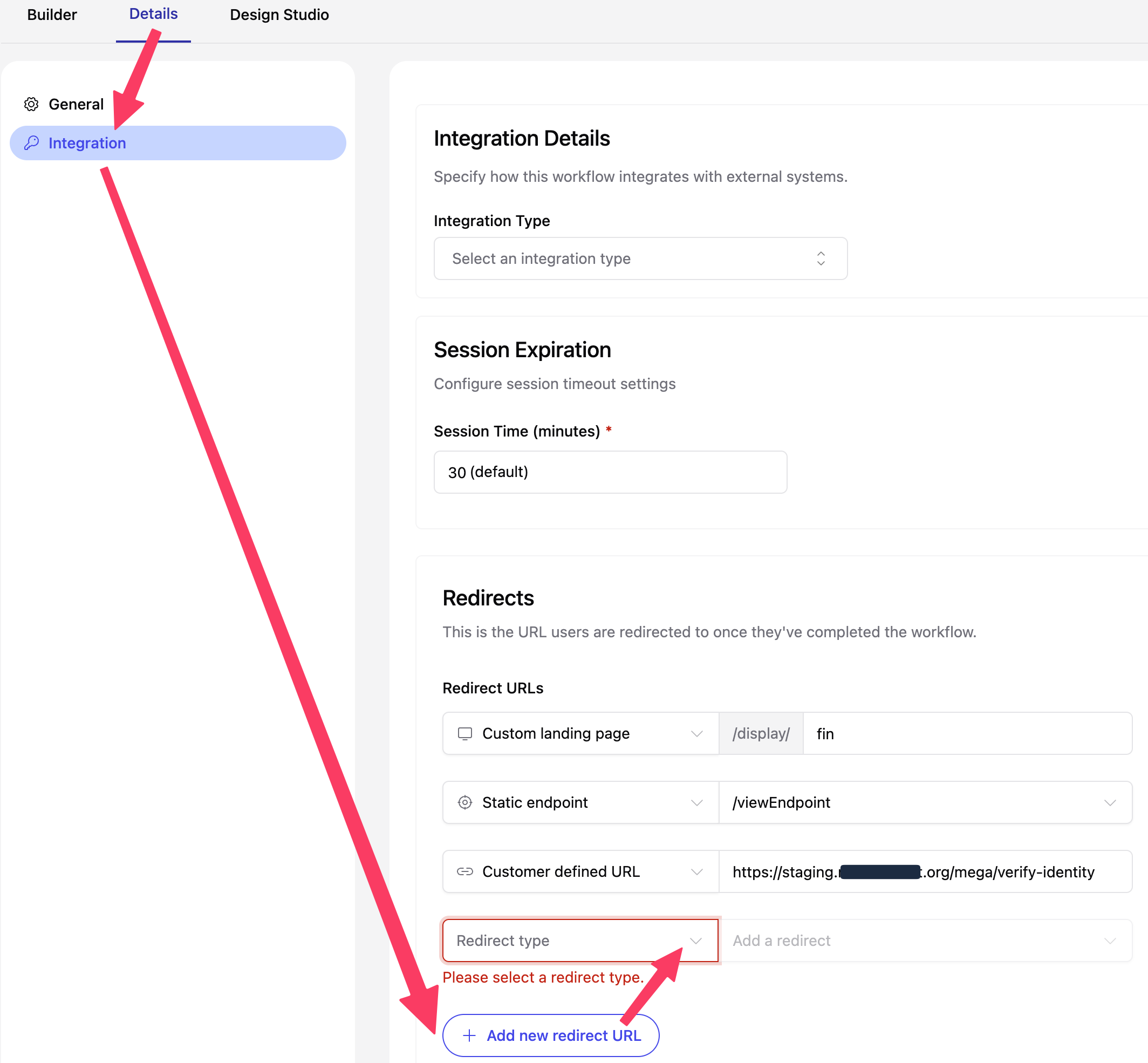
With your Workflow open, towards the bottom of the screen, click Add new redirect URL, then choose type and enter the new URL.
Redirect Types
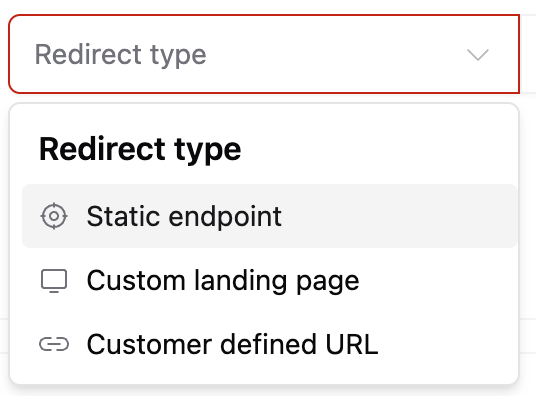
- Static endpoint — Allows redirecting users to a system-defined endpoint.
- Custom landing page — Allows redirecting users to a custom landing page path within the client application.
- Customer defined URL — Allows redirecting users to a fully qualified external URL.
Redirect URL Types
Redirect URL types determine where users are sent after completing a flow. Each redirect entry must be assigned a Redirect Type, which defines how the destination URL is selected, constructed, and validated.
Overview
The platform supports three redirect URL types:
| Redirect Type | Use When | URL Format |
|---|---|---|
| Static Endpoint | You want to redirect users to a supported platform-defined endpoint. | System-defined endpoint, such as /IDToken |
| Custom Landing Page | You want to redirect users to a page within your client application. | Relative path, such as /display/pagename |
| Customer Defined URL | You want to redirect users to a fully qualified external destination. | Full URL, such as https://customer-domain.com/verification-complete |
Static Endpoint
A Static Endpoint redirects users to a system-defined endpoint provided by the platform. These endpoints represent supported platform response paths and are selected from a predefined list.
Examples
/IDToken
/viewEndpoint
Configuration Behavior
When configuring a Static Endpoint redirect:
- Select Static Endpoint from the Redirect Type dropdown.
- Select one of the available system endpoints.
- Save the redirect configuration.
No manual URL entry is required. The destination is determined by the selected platform endpoint.
Notes
Static endpoints are managed by the platform. Only endpoints available in the dropdown are supported for this redirect type.
Custom Landing Page
A Custom Landing Page redirects users to a relative path within your client application. The path you provide is appended to the configured base domain for the client.
Example
/display/pagenameConfiguration Behavior
When configuring a Custom Landing Page redirect:
- Select Custom Landing Page from the Redirect Type dropdown.
- Enter the relative landing page path.
- Save the redirect configuration.
The platform appends the relative path to the configured base domain.
Example Result
If the configured base domain is:
https://customer-domain.comAnd the configured landing page path is:
/display/pagenameThe resulting redirect destination is:
https://customer-domain.com/display/pagenameNotes
Use this option when the redirect target is hosted within your own client application and can be represented as a relative path.
Customer Defined URL
A Customer Defined URL redirects users to a fully qualified external URL. This option is used when the destination is not represented by a platform endpoint or a relative client application path.
Example
https://customer-domain.com/verification-completeConfiguration Behavior
When configuring a Customer Defined URL redirect:
- Select Customer Defined URL from the Redirect Type dropdown.
- Enter the full destination URL.
- Save the redirect configuration.
The URL must pass the platform hostname validation rules before it can be used.
URL Requirements
Customer Defined URLs must be fully qualified and include the protocol and hostname.
Valid example:
https://customer-domain.com/verification-completeInvalid example:
/verification-completeA relative path should be configured as a Custom Landing Page, not as a Customer Defined URL.
Redirect Type Selection Guide
Use the following guidance when selecting a redirect type:
| Scenario | Recommended Redirect Type |
|---|---|
| Redirect to a platform-supported response path | Static Endpoint |
| Redirect to a page within the configured client application domain | Custom Landing Page |
| Redirect to a complete external URL | Customer Defined URL |
Validation Summary
| Redirect Type | Manual URL Input | Validation |
|---|---|---|
| Static Endpoint | No | Must be selected from the supported system endpoint list. |
| Custom Landing Page | Yes, relative path only | Path is appended to the configured base domain. |
| Customer Defined URL | Yes, full URL required | URL must pass hostname validation rules. |
Updated 5 months ago